What separates a middle manager who transforms their team from one who simply maintains it? The question is deceptively simple. Most frameworks default to broad categories — 'communication,' 'leadership,' 'results' — that are too abstract to be actionable and too generic to be diagnostic. They tell you what good looks like in the abstract. They do not tell you where a specific leader is falling short, or why.
The ACEND framework was built around a different question: what behaviours, practised consistently, produce the outcomes organisations care most about at the middle management layer? Through assessment data, we have identified five dimensions — Align, Change, Execute, Nurture, and Develop — that, taken together, predict whether a middle manager will multiply their team's capacity — or quietly constrain it.
For HR leaders comparing leadership training in Tanzania, the challenge is not simply finding a trainer or booking a workshop. It is choosing a leadership development programme that builds observable management behaviours, responds to the realities of Tanzanian organisations, and produces evidence of growth beyond the training room.
A — Align
Align is the dimension through which a middle manager translates strategy into team-level meaning. The ACEND model describes Align leaders as translators and sense-makers: they take direction set above them and turn it into priorities their team understands, believes in, and can act on. The dimension rests on three competencies — Flexibility, Emotional Intelligence, and Effective Communication.
The cascade problem — where executive strategy becomes progressively distorted as it passes through management layers — is almost always an alignment failure at the middle. Not a failure of grammar or unclear slides, but a failure to contextualise, prioritise, and make the strategy personally relevant to the team members responsible for executing it.
“The single most consistent finding in our assessment data: managers who score high on Align have teams that pull in the same direction without constant supervision. The correlation is not marginal — it is one of the strongest predictive signals in the entire framework.”
High-Align managers create clarity without over-specifying. Emotional intelligence lets them sense where their team actually is; flexibility lets them adjust the message without losing its intent. They listen in ways that actually change decisions, give feedback that is specific and timely, and make their teams feel informed, not just managed.
C — Change
Change, in the ACEND model, is not about surviving reorganisations. It describes the manager as catalyst and intrapreneur: the ability to read shifting contexts, adjust priorities without losing team coherence, and champion new directions rather than merely comply with them. Its underlying competencies are Agility, Decisiveness, and Persuasion.
In practice, this means a leader who can hold a clear vision while remaining genuinely responsive to new information. Who can absorb a significant stakeholder shift on a Monday and have their team aligned and moving by Wednesday. Who treats ambiguity not as a threat to be avoided but as a context to be navigated with clarity.
High Change capability at the middle manager level manifests as:
- Proactive identification and escalation of delivery risks before they cascade.
- Rapid realignment of team priorities when strategic direction shifts.
- Decisiveness under uncertainty — transparent, timely calls that are reversible where possible.
- Persuasion that brings sceptical stakeholders and team members along, rather than relying on positional authority.
Low Change capability, by contrast, manifests as reactive management — issues surface late, decisions wait for clarity that never fully arrives, and teams experience repeated whiplash as the manager scrambles to catch up with a changing environment.
E — Execute
Execute is the dimension most organisations think they understand — and most consistently underinvest in developing. It is tempting to assume that results speak for themselves; if the team is delivering, execution must be fine. But the ACEND framework distinguishes between delivery that happens despite the manager and delivery that happens because of them. Execute combines Operational Mastery, Strategic Thinking, and Congruence — doing the work well, choosing the right work, and visibly doing what you said you would do.
Strong execution at the middle manager level means setting clear goals and maintaining accountability rhythms that keep delivery on track without creating a culture of surveillance. It means managing time, priorities, and energy across a team — not just one's own calendar. It means escalating the right issues at the right time, and knowing which decisions to absorb versus which to escalate.
The execution behaviours that most predict delivery consistency include:
- Regular, structured check-ins that create accountability without micromanagement.
- Clear priority-setting that the team can articulate independently.
- Disciplined management of scope, timeline, and stakeholder expectations.
- Congruence between stated priorities and actual behaviour — teams trust leaders whose actions match their words.
- A track record of completing strategic commitments, not just activity.
The most common execution failure pattern we see is the 'busy but not productive' manager — high activity, frequent meetings, always in motion — whose team nonetheless consistently misses deadlines or delivers outputs misaligned to the strategic objective. Busyness is not execution. Delivery is execution.
N — Nurture
Nurture is the culture dimension. The ACEND model describes Nurture leaders as designers and culture-keepers: they deliberately shape the environment their team works in — the values that get honoured, the standards that get held, and the safety people feel when they speak up. Its competencies are Value Driven leadership, Resilience, and Compassionate Accountability.
High-Nurture managers build the kind of trust that allows honest conversation — where people surface problems early, take risks without fear, and grow through failure rather than hiding from it. They hold high standards and genuine care in the same hand: accountability that is compassionate rather than punitive, and a personal resilience that absorbs setbacks without transmitting panic to the team.
The business case for Nurture is increasingly well-evidenced. Teams led by high-Nurture managers show measurably lower voluntary attrition and report higher levels of psychological safety — which, per Google's Project Aristotle and subsequent research, is the single strongest predictor of team effectiveness.
The leaders who score lowest on Nurture are typically not callous — they are simply so focused on delivery that culture becomes something that happens to their team rather than something they design. The cost is invisible until it isn't: a sudden attrition wave, an erosion of trust, a team that performs adequately but never breaks through.
D — Develop
The fifth dimension — Develop — is about growing people. The ACEND model describes Develop leaders as coaches and champions: managers who invest deliberately in their team members' growth, build teams that are stronger than the sum of their parts, and resolve the tensions that inevitably arise when capable people work under pressure. Its competencies are Others-Oriented Leadership, Tension Resolution, and Team Building.
High-Develop managers identify individual strengths and create stretch opportunities aligned to those strengths. They coach rather than rescue, champion their people's visibility and progression, and address friction early — before it calcifies into politics. Teams led by high-Develop managers grow internal talent at a faster rate and produce the organisation's next generation of leaders — the long-term leadership pipeline most organisations say they want and few deliberately build.
The Interplay Between Dimensions
What makes the ACEND framework diagnostically powerful is not any single dimension in isolation — it is the pattern across all five. A manager who is high on Execute but low on Nurture is a delivery machine with a retention problem waiting to happen. A manager high on Align but low on Execute creates informed, motivated teams that nonetheless miss targets. A manager high on Change but low on Develop drives adaptation their people cannot keep pace with — capable today, but not building the team that tomorrow's challenges will demand.
The 360° assessment at the core of ACEND captures not just the manager's self-perception but the perspectives of direct reports, peers, and line managers. The gaps between these — where a leader thinks they are strong and where others experience them as falling short — are often the most valuable data in the entire report. Blind spots, not known weaknesses, tend to derail careers.
Understanding where each middle manager sits across these five dimensions is the beginning of a genuine capability-building conversation — one that replaces guesswork with evidence and one-size-fits-all training with targeted, high-leverage development.
What Clients Say About WhyLead’s Leadership Facilitation
Client experience provides another useful signal when evaluating leadership trainers in Tanzania. WhyLead currently holds a 4.8-star rating from 273 Google reviews, with recurring feedback highlighting facilitators who understand the audience, adapt to organisational context, create engaging sessions, and support genuine collaboration.
““Quickly understood the audience and adapted his facilitation style to the client’s language and context.” — Osman Elhassan, Google review”
In the same review, Osman highlighted Jocelyne’s strength in documenting discussions, facilitating collaboration, managing surveys, and sustaining an engaging presence. He described Goodhope’s energy and positive attitude as making the activities enjoyable and impactful.
““Facilitators were excellent. Very engaging.” — Flix, Google review”
Another reviewer, Akram Ahmed, described the WhyLead team as polite, professional, and talented, and said the facilitation made the sessions genuinely enjoyable. Taken together, this feedback reinforces a central point of the ACEND framework: effective leadership development depends not only on content, but on skilled facilitation that responds to people, context, and the outcomes the organisation needs.
What to Look for in Leadership Training Programmes in Tanzania
The strongest leadership training programmes in Tanzania do more than deliver inspiring presentations. They connect training to the organisation’s strategy, diagnose each manager’s real development needs, create opportunities to practise new behaviours, and measure whether those behaviours transfer back into day-to-day work.
When evaluating leadership trainers or management training programmes in Tanzania, HR and learning teams should look for:
- A clear leadership framework with behaviours that managers, direct reports, and line managers can recognise and assess.
- Facilitators who understand the Tanzanian business environment while bringing regional and global leadership-development experience.
- Practical learning methods such as cohort sessions, coaching, peer reflection, workplace assignments, and 360° feedback.
- A programme designed specifically for middle managers rather than generic training applied to every leadership level.
- Evidence of impact, including baseline data, progress measures, and a plan for sustaining development after the workshop.
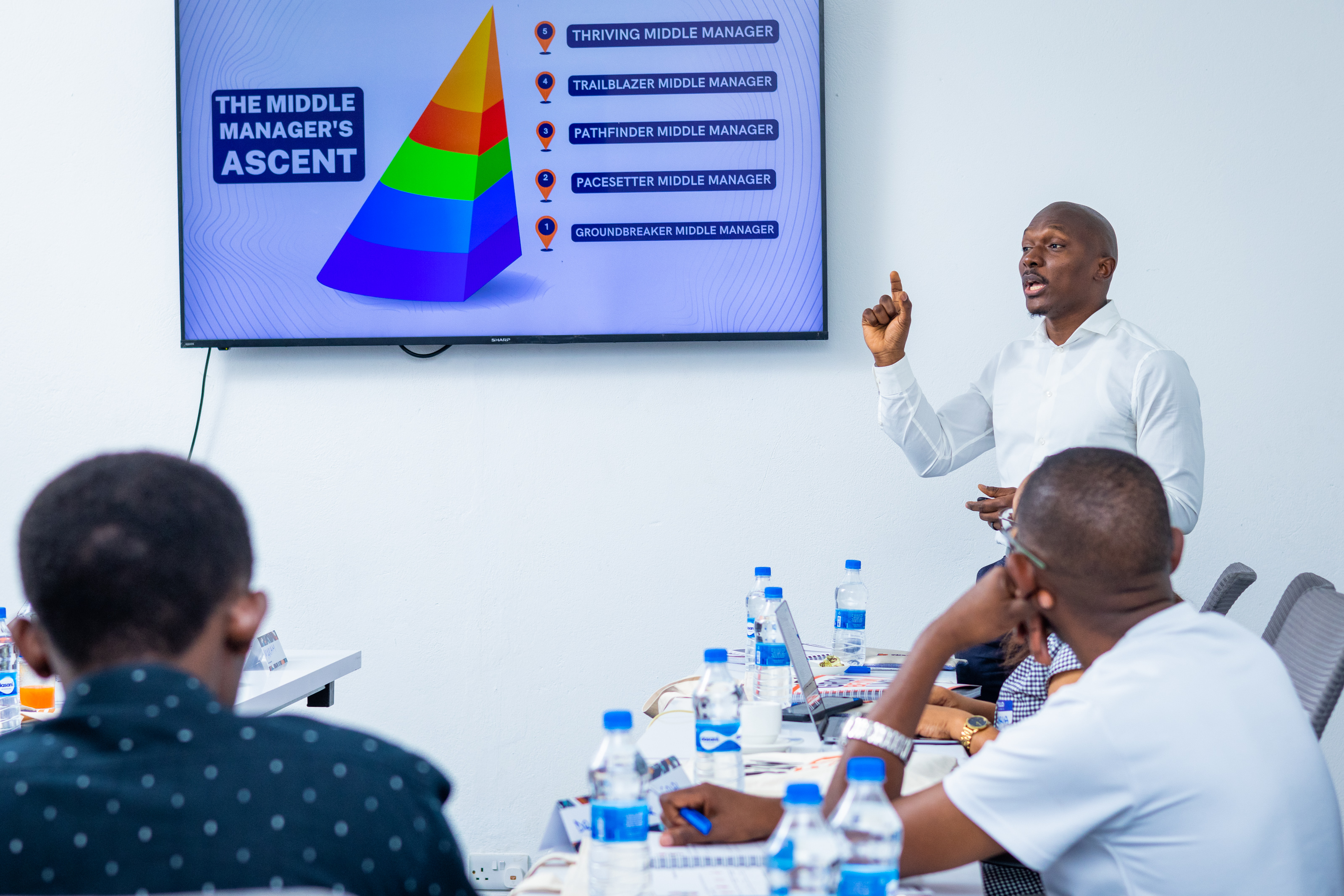
WhyLead’s leadership trainers in Tanzania use the ACEND 360° assessment alongside Thrive in the Middle to turn these principles into a targeted leadership development journey. Organisations looking for corporate leadership training in Dar es Salaam or across Tanzania can use the five ACEND dimensions — Align, Change, Execute, Nurture, and Develop — to identify capability gaps, focus development investment, and strengthen the managers responsible for turning strategy into execution.

Assess your middle managers for free.
The ACEND readiness tool gives you a data-backed signal on any leader in under 5 minutes.
More Insights
Why Middle Managers Are Your Most Overlooked Leverage Point
Every CEO can name their top 10 executives. Very few can name the 30 middle managers quietly determining wheth…
Read article →Thrive in the Middle: Why Cohort-Based Development Works Where Courses Don't
Most middle manager training fails within 90 days. The knowledge transfers; the behaviour doesn't. Thrive in t…
Read article →