
The corporate learning industry produces an extraordinary amount of training that doesn't change behaviour. Managers attend workshops. They complete e-learning modules. They sit through half-day seminars on 'effective leadership.' By the following month, the day-to-day patterns are largely unchanged — not because the managers didn't engage, but because the training model was never designed to produce lasting behavioural change in the first place.
This is not a cynical view. It is the consistent finding of learning science. Transfer of training — the degree to which what is learned in a programme actually changes what a person does back in their job — is the most persistently underperforming metric in the entire L&D field. And nowhere is the transfer failure more consequential than at the middle management level, where the stakes of changed (or unchanged) behaviour are multiplied across entire teams.
Why Traditional Training Fails
The failure pattern is consistent and well-documented. A training event creates a short-term spike in awareness and motivation. Managers leave energised. Within 30 days, the energy fades as the realities of the job — back-to-back meetings, urgent deliverables, a team member in crisis — crowd out any space to practise new behaviours. Within 90 days, the training has largely reverted to background noise.
The structural reasons traditional training fails to produce sustained change include:
- Event-based learning: a single intensive event produces short-term activation, not long-term habit formation.
- No application scaffold: managers learn concepts in the abstract but have no structured support for applying them in the specific, messy reality of their actual job.
- Isolation: individual training creates no peer accountability. No one notices if the manager stops practising.
- No measurement: without data on what is actually changing, there is no feedback loop and no visibility of whether the investment is working.
- Misaligned incentives: if the organisation's culture and systems don't reinforce the behaviours being trained, the training is working against gravity.
The Cohort Model: Structure as the Change Mechanism
Thrive in the Middle is built on a fundamentally different theory of change. Rather than treating a training event as the mechanism of change, it treats structure as the mechanism. The programme creates conditions in which behaviour change becomes structurally supported — and structurally accountable.
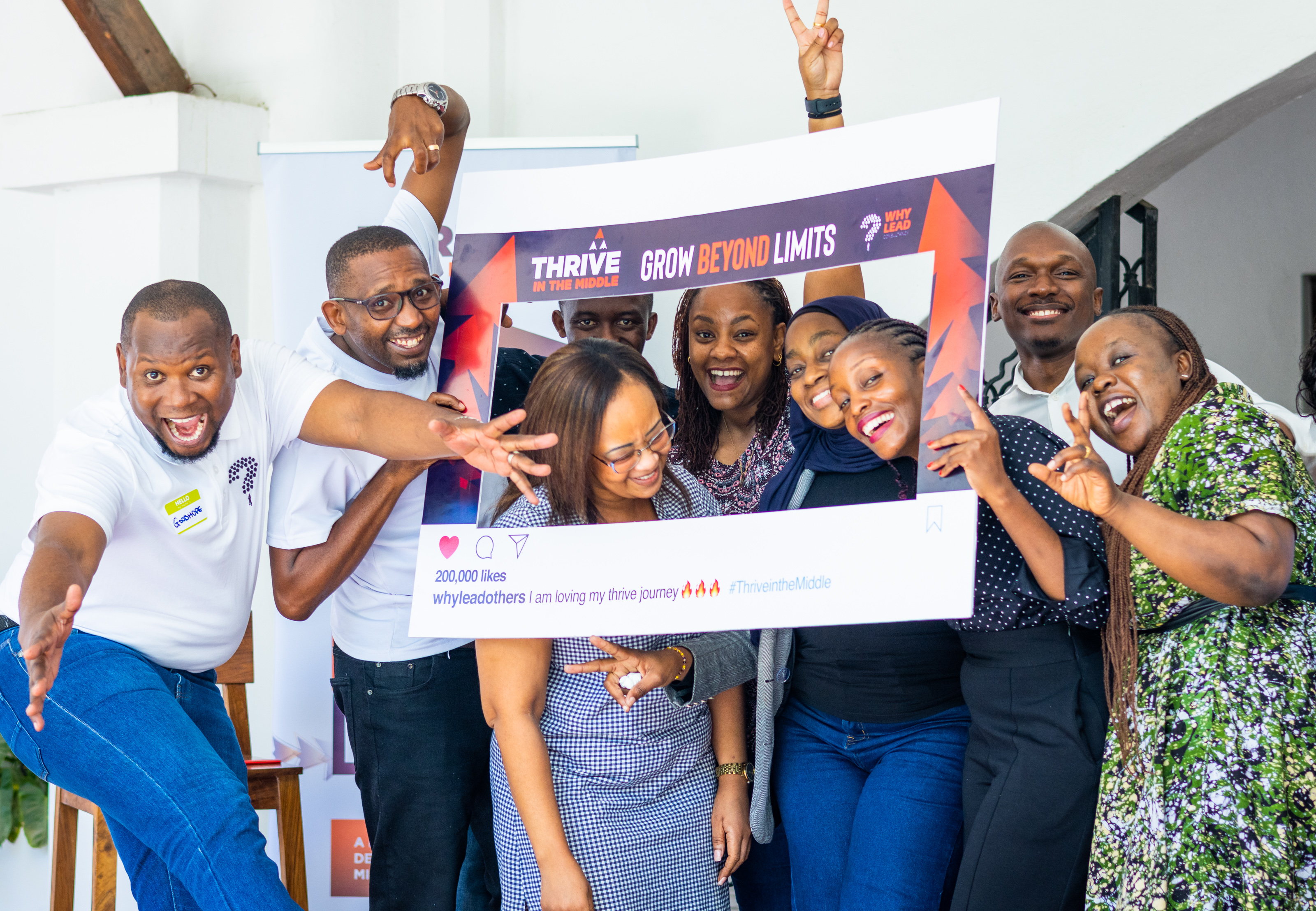
The cohort model matters because learning in isolation does not stick. When middle managers go through a structured development experience alongside their peers — people at the same level, navigating the same pressures — three things happen that don't happen in individual training.
1. Social accountability replaces willpower
Behavioural change is hard. It requires sustained effort in the face of competing priorities and the constant pull of established habit. Individual willpower is, by definition, a finite resource. Social accountability — the awareness that peers who know your goals will ask how you're progressing — is a far more reliable mechanism. Cohort participants don't just commit to their own development; they commit to each other. This creates a layer of accountability that persists between formal sessions.
2. Peer learning surfaces what expert instruction misses
A facilitator brings expertise and frameworks. Peers bring practical wisdom — the specific, contextualised knowledge of how to navigate real situations in this organisation, with these stakeholders, under these constraints. When a manager describes a specific challenge they're navigating and three peers who understand the context respond with what they've tried, what worked, and what didn't, the learning is immediately applicable. It is the difference between studying a map and getting directions from someone who has made the same journey.
3. Shared language creates organisational change, not just individual change
When a cohort of middle managers goes through a shared development experience and arrives at a shared vocabulary for what good leadership looks like — what 'accountability' means in practice, what 'strategic communication' looks like in action — the effect extends beyond the individuals. Conversations between managers become more calibrated. Standards become more consistent. The culture shifts, incrementally but measurably, because multiple people are using the same framework to make sense of their work.
The Thrive in the Middle Design Principles
The Thrive in the Middle programme integrates five design principles that directly address the transfer problem.
- 1Assessment-first: every participant begins with an ACEND 360° assessment. Development is built around individual data, not generic frameworks. Managers know specifically what to work on, why it matters, and how their raters experience their current practice.
- 2Spaced over time: rather than a single intensive event, the programme is delivered across a meaningful duration, with structured sessions spaced to allow application and reflection between them. Habit formation requires repetition with feedback — not a single exposure.
- 3Practice-embedded: each session ends with a specific behavioural commitment — something small and concrete the participant will do differently in the following two weeks. The commitment is specific, observable, and shared with the cohort.
- 4Coaching integration: facilitated group sessions are supplemented with targeted coaching for individual development priorities. The coach works with the ACEND data to create a focused, personalised development conversation.
- 5Close-loop measurement: the programme ends where it begins — with a reassessment using the ACEND framework. Growth is quantified. The development story is visible. And the organisation has evidence to inform talent decisions.
“The goal of Thrive in the Middle is not to produce managers who have attended a programme. It is to produce managers who lead differently — and an organisation that can see the difference.”
What Organisations Should Expect
Organisations that run Thrive in the Middle as part of a broader ACEND deployment typically see measurable movement across the four ACEND dimensions within the programme period. The dimensions that tend to show the most significant early movement are Communication and Execution — because these are the areas where structured practice produces the fastest observable feedback. Agility and Nurture tend to show more gradual but deeper movement, reflecting the longer timeframe required to shift relational and adaptive leadership patterns.
Beyond the individual data, organisations consistently report three broader outcomes: a more consistent accountability culture across the management layer; reduced voluntary attrition among teams led by programme participants; and an accelerated internal leadership pipeline, with programme graduates consistently rated as stronger candidates for senior roles.
The Business Case in Simple Terms
If a single middle manager leads a team of 10, and that manager's development reduces voluntary attrition by even one person per year, the organisation recovers the full cost of a structured development programme — before accounting for any productivity gain, delivery improvement, or cultural impact.
The question organisations should be asking is not 'can we afford Thrive in the Middle?' The question is: 'how many of our current middle managers are leading at the level we actually need — and how long are we willing to wait for that to change by accident rather than by design?'

The organisations that build systematically at the middle layer don't just develop better managers. They build organisations that can execute — which, in the end, is what every strategy depends on.
Assess your middle managers for free.
The ACEND readiness tool gives you a data-backed signal on any leader in under 5 minutes.
More Insights
Why Middle Managers Are Your Most Overlooked Leverage Point
Every CEO can name their top 10 executives. Very few can name the 30 middle managers quietly determining wheth…
Read article →The Five Dimensions That Define High-Impact Middle Managers
After assessing hundreds of middle managers across sectors, five dimensions consistently separate those who mu…
Read article →