
Most people think facilitators create breakthroughs. I don't think we do. At WhyLead Consultancy, we often describe ourselves as wachimba mfereji - a Swahili phrase that means ditch diggers. It may sound unusual, but it perfectly captures how we think about leadership facilitation. A ditch digger doesn't create the water. They don't control where the rain falls. Their job is to remove the obstacles and prepare the ground so that, when the water comes, it has somewhere to flow. That is how we see our role in strategy workshops, leadership retreats, team development, and organizational transformation. Organizations already hold all the wisdom they need. Our work is to help it flow.
Digging before the water comes
One of the biggest misconceptions about facilitation is that the real work begins when people enter the room.
It doesn't.
The room is simply where everyone sees the work. The real work happens beforehand.
Before designing a leadership retreat or strategic planning workshop, we spend time understanding what success actually looks like. We ask difficult questions. We listen to different perspectives. We examine existing data. We pay attention to what is being said - and often, what isn't.
Like a ditch digger studying the landscape before lifting a shovel, we believe that understanding the terrain determines whether the water will eventually reach its destination.
This preparation has become one of the defining characteristics of our work. When Malala Fund engaged WhyLead to design and facilitate a three-day retreat after years of operating as a fully remote organization, the objective wasn't simply to "run a retreat." The deeper need was rebuilding trust, strengthening relationships, and reconnecting people around a shared purpose.
After the retreat, Lisa Biancalana, Acting COO, shared:"We walked away with a sense of greater bonding, a renewed sense of purpose, and refreshed excitement to go back to our work."
That outcome wasn't accidental.
It was designed long before the first session began.
Great facilitation is intentional by design
Water rarely follows a random path.
Neither should a workshop.
Every activity, discussion, reflection, break, question, and transition should serve a purpose.
One exercise may be designed to build trust. Another to surface difficult conversations.
Another to generate alignment around strategy. Every moment should move people one step closer to the outcome they came for.
This is why facilitation is much more than standing in front of a room.
It is experience design.
The Malawi Country Director at D-tree, who attended a retreat facilitated by WhyLead, captured this beautifully:"One of the best retreats in my life. Loved the energy and the connection between the activities and the targeted outputs of the retreat."
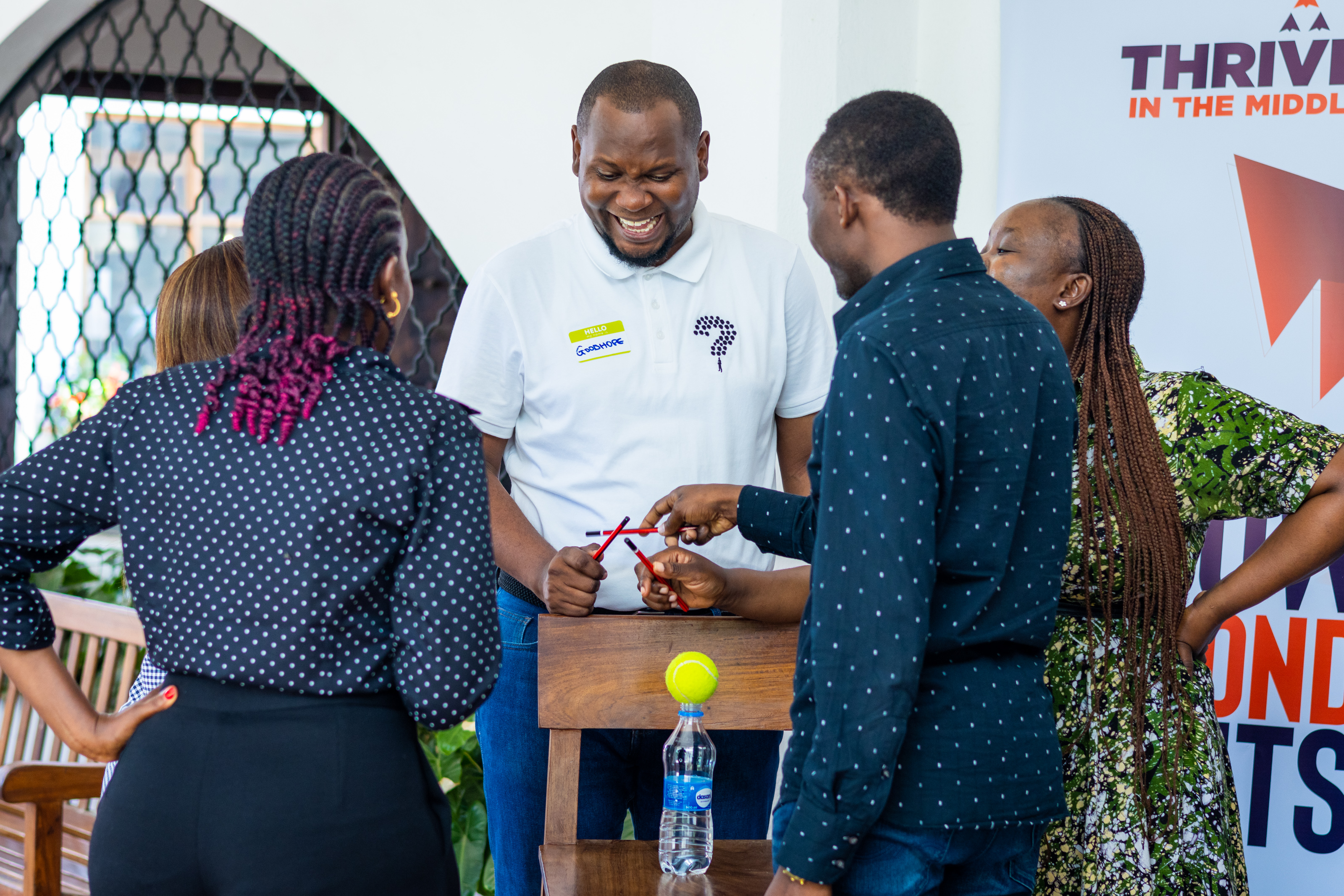
Another participant, Booker Msambaji, echoed a similar sentiment, highlighting the intentionality behind the experience:"The manner in which the team activities have been designed is very interesting, engaging, and informative. Well done to WhyLead."
Those comments meant a great deal to us - not simply because they praised the experience, but because they recognized something we work hard to achieve: every activity is designed with purpose. Energy is never the goal on its own. Every conversation, reflection, and exercise exists to move people closer to the outcomes they came to achieve.
That connection is never left to chance.
Listening between the lines
One of the most important skills in organizational development isn't speaking. It's listening. Not just to the words people use. But to the hesitation before they answer. The disagreement no one wants to raise. The repeated themes that keep surfacing. The ideas people struggle to articulate. Organizations rarely lack solutions. More often, they lack the language to express what they already know. As facilitators, our responsibility is not to provide all the answers. It is to ask the questions that allow people to discover them together. Sometimes the breakthrough isn't a new strategy. Sometimes it's finally naming the problem everyone has been quietly carrying. That is part of digging the ditch.
Data helps the water flow
At WhyLead, one of our core beliefs is simple: Better conversations require better information. And better information requires better questions.
We are deeply data-driven because assumptions make shallow foundations.
Whenever possible, we seek interviews, surveys, organizational documents, strategic priorities, and stakeholder perspectives before designing a workshop or leadership programme.
Data doesn't remove emotion. It gives emotion direction.
It helps teams move beyond opinions and towards informed decisions.
When the ground has been studied well, the digging becomes purposeful.
We believe that when facilitation is informed by evidence and guided by thoughtful design, people notice the difference.
Following a strategy formulation kickoff in Dar es Salaam, Mr. Saif Ibrahim - the finance director from a mining company said;"I had the pleasure of attending WhyLead's strategy formulation kickoff in Dar es Salaam. I was very impressed by their knowledge, professionalism, and skills. I highly recommend them without reservation. Thank you, WhyLead."
Ubuntu comes before facilitation
Our first value at WhyLead is Ubuntu Kwanza. People first. Always. Before strategy. Before frameworks. Before performance. Because organizations do not change. People do. Every leadership workshop, executive retreat, or strategy session is ultimately about creating an environment where people feel safe enough to think honestly, challenge respectfully, and contribute fully. Without psychological safety, even the best-designed workshop becomes another meeting. With it, conversations become catalysts for transformation.
We don't create the water
Over the years, we've had the privilege of facilitating leadership retreats, strategic planning sessions, and organizational development processes with organizations including Malala Fund, Ubongo, RIDA Group, CMA CGM, NEST 360, and many others across Africa. Every organization has been different. Every challenge has been unique. But one lesson has remained constant. We are not there to be the smartest people in the room. We are there to prepare the room so that the people inside it can do their best thinking. That is what it means to be wachimba mfereji. We dig. We listen. We ask. We design. We create space. And when the conditions are right, something remarkable happens. The water begins to flow.
Assess your middle managers for free.
The ACEND readiness tool gives you a data-backed signal on any leader in under 5 minutes.
More Insights
Why Middle Managers Are Your Most Overlooked Leverage Point
Every CEO can name their top 10 executives. Very few can name the 30 middle managers quietly determining wheth…
Read article →The Five Dimensions That Define High-Impact Middle Managers
After assessing hundreds of middle managers across sectors, five dimensions consistently separate those who mu…
Read article →